Direct Owners, Executive Officers, and Corporate Governance
The applicant or licensee must identify all Direct Owners with 10% or more ownership and Executive Officers.
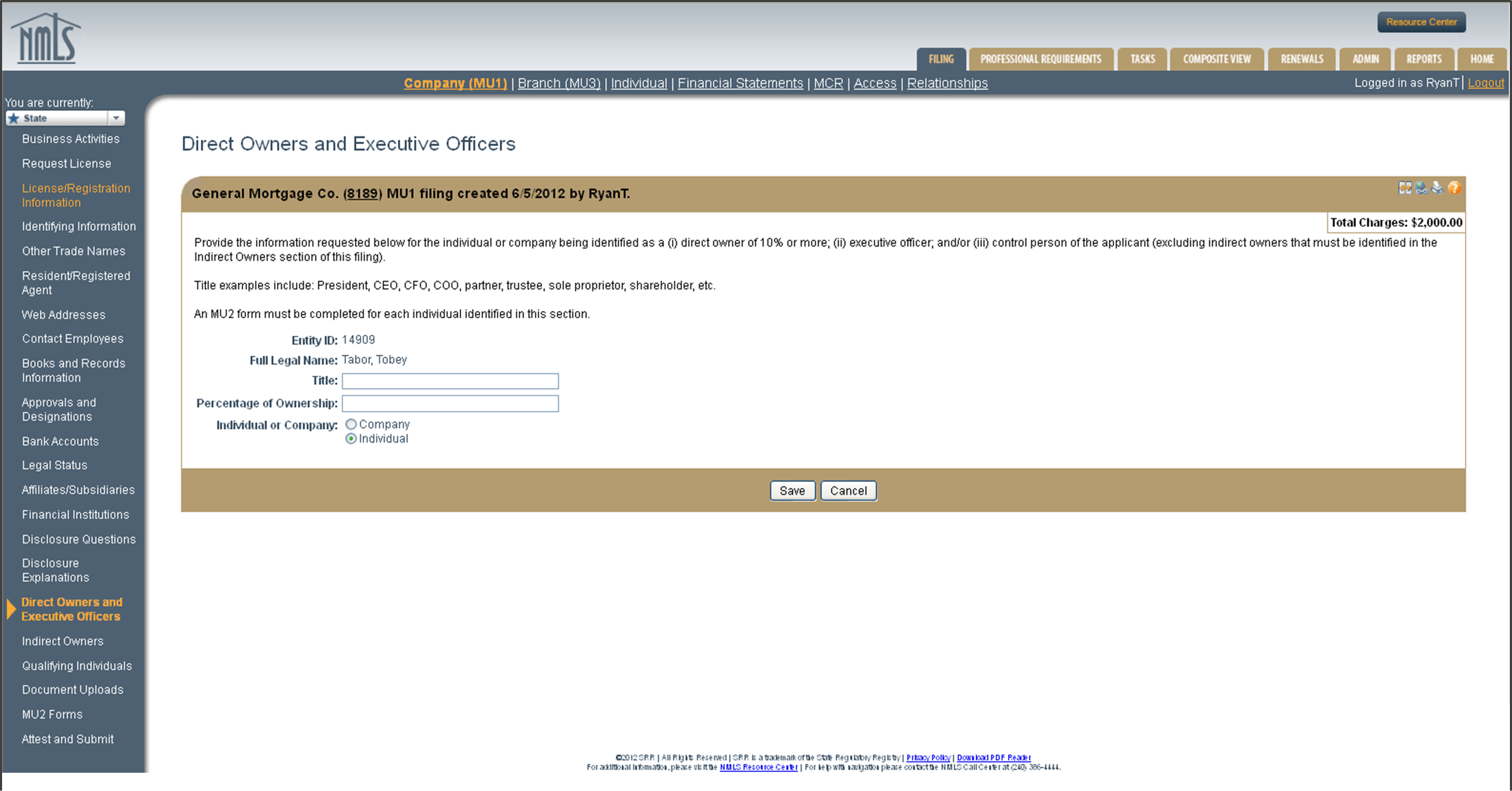
Entity ID, Full Legal Name, Title, and Percentage of Ownership
If the direct owner or executive officer is a natural person (individual), the applicant or licensee should list their full legal name as First, Middle, Last, Suffix, provide their title and the percentage of ownership. All natural persons listed in the Direct Owners and Executive Officers section of the Company Form (MU1) are required to complete and submit an Individual Form (MU2).
CONTROL is determined in several ways:
- Equity Owners – an entity or individual that, directly or indirectly has the right to vote 10% or more of a class of a voting security or has the power to sell or direct the sale of 10% or more of a class of voting securities. In the case of a partnership, an entity or individual that has the right to receive upon dissolution, or has contributed, 10% or more of the capital, is presumed to control that company.
- Corporate Governance – as set out in the most recent Articles of Incorporation,
Articles of Organization, or Partnership Agreement.
- Board of Directors, Board of Managers, Member Manager, General Partner, or similar governing body, whether they are compensated or not.
- President, Executive Vice President, Senior Vice President, Treasurer, Secretary, or similarly elected or appointed senior corporate officers
- Functional Responsibility – Individuals, regardless of title, who have the power, directly or indirectly, to direct the management or policies of a company by contract, or otherwise. Job description holds individuals responsible for the operational, financial, information technology, compliance, and/or security functions of the company, including Chief Executive Officer, Chief Financial Officer, Chief Operations Officer, Chief Legal Officer, Chief Credit Officer, Chief Compliance Officer, and individuals occupying similar positions or performing similar functions. Other required individuals may include qualified persons, location supervisors, and branch managers.
| Applicant Type | Equity Owners | Corporate Governance | Functional Responsibility | |
|---|---|---|---|---|
| “C” Corporation | Shareholders ≥10% |
All members of Board of Directors | Elected or Appointed Officers | Chief Officers & other required individuals |
| “S” Corporation | Shareholders ≥10% |
All members of Board of Directors | Elected or Appointed Officers | Chief Officers & other required individuals |
| Limited Liability Company | All Members ≥10% |
Member Managed (Managing Member) All Managers (Board of Managers) |
Elected or Appointed Officers | Chief Officers & other required individuals |
| Partnership | All Partners ≥10% |
General Partner | Elected or Appointed Officers | Chief Officers & other required individuals |
The following points will help companies decide who to include:
- Direct Owners
-
Direct owners include any person that owns, beneficially owns, has the right to vote, or has thepower to sell or direct the sale of 10% or more of a class of voting security of the applicant or licensee. For purpose of this section, a person beneficially owns any securities (i) owned by his/her child, stepchild, grandchild, parent, stepparent, grandparent, spouse, sibling, mother-in-law, father-in-law, son-in-law, daughter-in- law, brother-in-law or sister-in-law, sharing the same residence; in cases where the company is a partnership, all general partners and those limited and special partners that have the right to receive upon dissolution, or have contributed, 10% or more of the partnership’s capital.
In the case of a trust that directly owns 10% or more of the class of voting security of the applicant, or that has the right to receive upon dissolution, or have contributed, 10% or more of the applicant or licensee’s capital, the trust and each trustee.
In the case where the company is a Limited Liability Company (“LLC”), (i) if member managed, the managing member, (ii) if managed by elected or appointed managers, all elected or appointed managers; and (iii) those members that have the right to receive upon dissolution, or have contributed, 10% or more of the LLC’s capital. In the case where the company is a partnership, (i) all general partners, and (ii) those limited and specialpartners that have the right to receive upon dissolution, or have contributed, 10% or more of the partnership’s capital.
In certain states, other required persons, including “qualified persons” or branch supervisors.Consult the state licensing requirements in which the applicant or licensee is applying for details.
Ownership must be disclosed as it is found on the organizing documents of an entity. Ownership disclosure in NMLS is not dependent on community property statutes and thereforeshould be represented in NMLS as found on legal organizing documents for the entity.
- Control Person
- A control person is an individual (natural person) that directly or indirectly exercises control over the applicant or licensee. This definition includes any individual that is a “director,general partner, or executive officer.” The term director includes all members of a company’s board of directors, including board members that are not employees of the company.
- Stock Symbol
- Provide the stock symbol (if the company is publicly traded).
- SSN or EIN
- Provide the person’s social security number or the company’s tax identification number or employer identification number, as issued by the IRS.
- Individual or Company
- All direct owners of 10% or more should be identified, regardless of the applicant or licensee’sbusiness structure. All individuals listed in this section are required to complete and submit an Individual Form (MU2).